Price your own round. In three working sessions.
The teaching blocks are short on purpose. Each step is taught in eight to twelve minutes against one worked company — then you build the same number on your own, in a workbook, with the model open, and the arithmetic checked before you leave.
There is a webinar for the theory. If you want to watch someone reason through how investors pric
The teaching blocks are short on purpose. Each step is taught in eight to twelve minutes against one worked company — then you build the same number on your own, in a workbook, with the model open, and the arithmetic checked before you leave.
There is a webinar for the theory. If you want to watch someone reason through how investors price MedTech risk, that exists and we will send it. This is the other thing. You cannot get your own number, with someone pressure-testing it, from a recording.
What we do
- Teach each step in eight to twelve minutes, using one worked company.
- Show you the arithmetic, then get out of the way.
- Move between founders while you work.
- Pressure-test two or three companies out loud in every session.
What you do
- Build your own numbers, on your own company, in the workbook.
- Use the Cap Builder to compute rather than estimate.
- Volunteer at least once — the pressure-testing is the point.
- Leave with a one-page capital plan and a cap range.
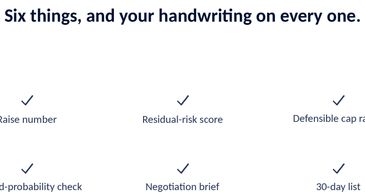
By the end of session three, every page of the workbook has your writing on it — and the last page is a one-page capital plan you could put in front of a co-founder that night.
A raise number — sized from the cost of your next milestone, not from months of burn, with every dollar attached to a named job.
A residual-risk score (WRXS) — your
By the end of session three, every page of the workbook has your writing on it — and the last page is a one-page capital plan you could put in front of a co-founder that night.
A raise number — sized from the cost of your next milestone, not from months of burn, with every dollar attached to a named job.
A residual-risk score (WRXS) — your risk decomposed across five weighted dimensions, with the one that dominates your valuation named.
A defensible cap range — a ceiling, a comfortable opening number, and the four inputs that produced both.
An implied-probability check — run against the cap you were about to ask for, before an investor runs it on you.
A negotiation brief — your BATNA in one sentence, and a written answer to the four objections you are most likely to hear.
A 30-day list — what to go and evidence next, in priority order.
This produces a defensible range for a negotiation. It is not your valuation, and we will not call it one.

Session 1 · Where you stand Runway, the capital-optional test, and a raise sized from your milestone rather than the calendar. You leave with a costed raise number and a BATNA sentence you would say out loud.
Session 2 · What it is worth Your residual risk, decomposed and weighted, with your dominant risk named, then what the company is w
Session 1 · Where you stand Runway, the capital-optional test, and a raise sized from your milestone rather than the calendar. You leave with a costed raise number and a BATNA sentence you would say out loud.
Session 2 · What it is worth Your residual risk, decomposed and weighted, with your dominant risk named, then what the company is worth today and what the round it is bridging to actually prices at.
Session 3 · What price you can hold Your clearance probability, built from evidence rather than optimism. Your downside, named. The four inputs combined into a cap range, then the instrument, the dilution, and how you hold the number in the room.
The gaps between sessions are part of the design. Each one sends you away for a real number — a regulatory quote, a cited piece of evidence — that the next session runs on. Founders who do that work leave with a materially better range.